
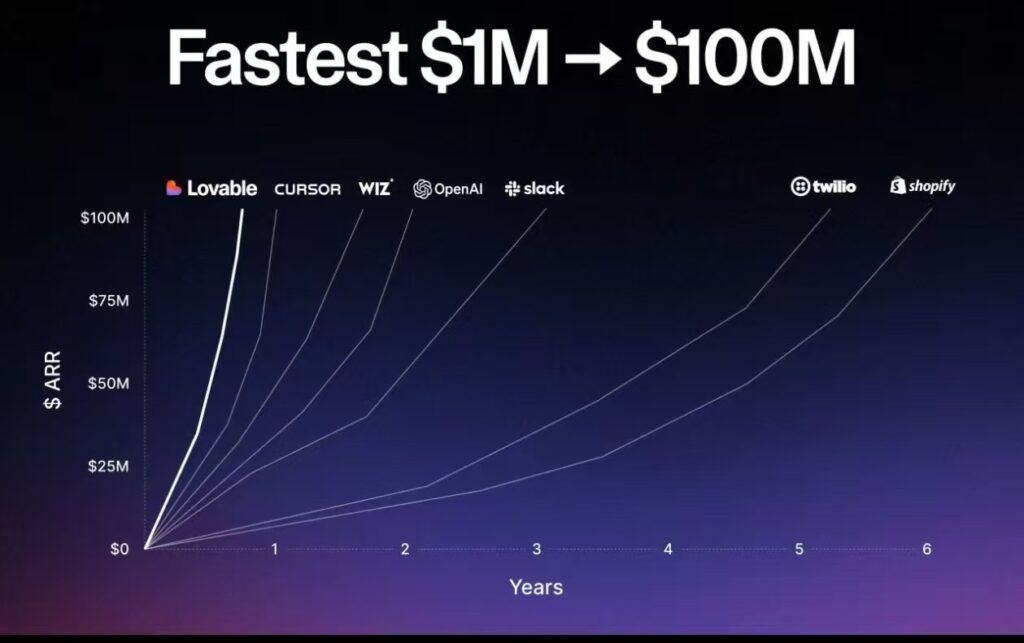
In 2024, Lovable was founded.
Eight months later, it hit $100M in ARR.
Four months after that, ARR doubled again to $200M. As of today, Lovable is widely regarded as thefastest company on record to scale from product launch to $200M ARR. Then came December: a $330M Series B led by CapitalG and Menlo Ventures, valuing the company at $6.6B.
On paper, this looks like another AI rocket ship story.
But here’s the part most growth breakdowns miss:
Lovable didn’t win by optimizing funnels.
There was no breakthrough in ads, no clever SEO play, no sales hack hiding in the numbers.
Instead, Lovable rebuilt growth around a single idea:
the product itself is the channel — and everything else compounds from there.
This isn’t just a fast-growing company.It’s a signal that the traditional SaaS growth playbook is breaking — and something fundamentally different is taking its place.
The Core Strategy: Product = Distribution
Lovable fundamentally rejects the traditional SaaS growth model where product,marketing, and distribution are separate functions.
Instead, it treats:
·Product usage as marketing
·Users as distribution nodes
·Free users as a marketing budget, not a cost center
Even with high AI inference costs and lower margins than classic SaaS, Lovable deliberately
chose Freemium growth strategy.
Their logic is blunt:
“We’d rather give the product away than pay Google or Meta to rent attention.”
This reframes CAC entirely:
Free usage ≠ lost revenue
Free usage = paid exposure, powered by real value
The Growth Engine: Six Key Product-Led Growth Strategies
1.Speed as a Moat
Shipping velocity is the competitive advantage.Lovable abandoned quarterly or even monthly releases.They ship daily — sometimes hourly.
This does three things:
. Keeps users constantly engaged(” this product is alive”)
. Turns every release into shareable content
. Makes competitors structurally slower, not just worse
To enable this, Lovable promotes AI-native employees:
·Blurred roles
·Engineers who ship end-to-end
·Less handoffs, less bureaucracy, more output
Speed isn’t just execution — it’s branding.
2.Replacing Brand Storytelling with Visible Progress
Lovable doesn’t invest heavily in polished brand campaigns.
Instead, they practice“build in public”:
·Shipping updates
·Real feature demos
·Honest iteration, even when imperfect
Their internal benchmark isn’t:
“Does this align with our brand narrative?”
It’s:
“Is this experience lovable?”
Brand trust is built through observable momentum, not slogans
3.Ecosystem Leverage Instead of Channel Building
Lovable doesn’t try to brute-force distribution from zero.They actively integrate into platforms that already have users:
·AI marketplaces
·Emerging app stores
·Existing tool ecosystems
This is classic leverage thinking:
”Don’t build an audience if you can plug into one.“
Early positioning on new platforms gives them asymmetric upside with minimal acquisition cost.
4.Founder & Employee Social Gravity
Lovable treats social media not as “marketing,” but as presence.
Founders and employees are encouraged to:
·Share product progress
·Talk openly about decisions
·Engage directly with users
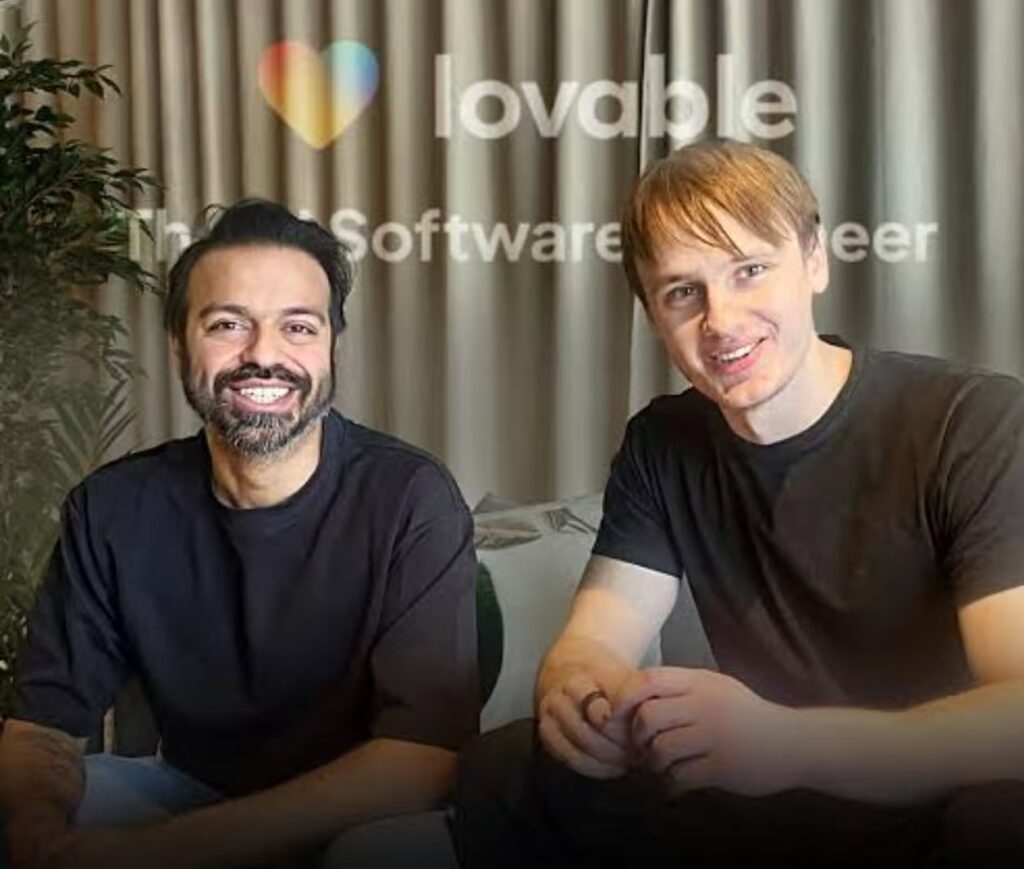
CEO Anton Osikais the clearest example:
·Started with zero audience
·Built reach organically on X and LinkedIn
·No ads, no hype — just consistent, transparent sharing
This humanizes the company and creates trust before conversion
5.Extreme Simplicity: Compressing the Value Path
Lovable aggressively minimizes time-to-value.
Key principle:
From idea → result in as few seconds as possible.
Examples:
·No mandatory signup to try the product
·Immediate interaction in the input box
·Fast “aha moment” before friction appears
This matters because:
·Viral loops die if value is delayed
·Sharing only happens after delight
They optimize for first magic, not on boarding tutorials
6.Creation-Driven Virality
Lovable isn’t positioned as a tool — it’s a creation platform.
Users don’t just “use” it.They make things.And crucially:
·Outputs are easy to share
·Results are visible and concrete
·Creations function as social proof
This beats referral programs because:
·People share work, not ads
·The output itself sells the product
Every shared creation is a live demo.
The Structural Shift: From Funnels to Growth Loops
Traditional SaaS growth looks like this:
·Buy traffic
·Convert users
·Optimize funnel leakage
Lovable operates on self-reinforcing loops:
| Traditional SaaS | lovable |
| Paid acquisition | Product-driven exposure |
| Funnel optimization | Creation loops |
| Brand campaigns | Public progress |
| Storytelling | Visible shipping |
| Ads | Social proof via output |
Additional Insights from External Sources
1.“Minimum Lovable Product” > MVP
Lovable explicitly rejects the idea that “usable” is enough.
Their bar:
·If users don’t want to share it, it’s not ready.
·Virality isn’t an add-on — it’s a product requirement.
2.Community as a Growth Asset
Lovable’s Discord and user communities aren’t support channels.
They serve as feedback engines, retention drivers and secondary distribution layers
Community isn’t post-growth.
Itisgrowth.
Abstract Models You Can Reuse for SaaS Growth
Model 1 : Creation → Sharing → Acquisition Loop
Flow:
User creates → Output shared → Social validation → New users try → Repeat
This is Lovable’s primary engine.
Model 2 : Velocity as Brand
Flow:
Ship fast → Public updates → Attention → Anticipation → Loyalty
Speed becomes identity
Final Take: Key Lessons for AI-Native SaaS Growth
Lovable didn’t win because they ran smarter ads or better funnels.
They won because of their advanced AI SaaS growth strategies:
·Treated growth as a product problem
·Turned users into distributors
·Made shipping speed and creation the core brand signals
This is what AI-native growth actually looks like —and most SaaS companies are still playing the old game.